
Compulsion
Ritual Design Pt. 2

Ritual Compulsion
As a little man, I found an intermingling sense of joy, fulfillment, anxiety, and shame surrounding many of my little extra-curricular ritual activities. At that age and in that time, it wasn’t commonly discussed among my friends, and adults shrugged many of them off as childish phases.
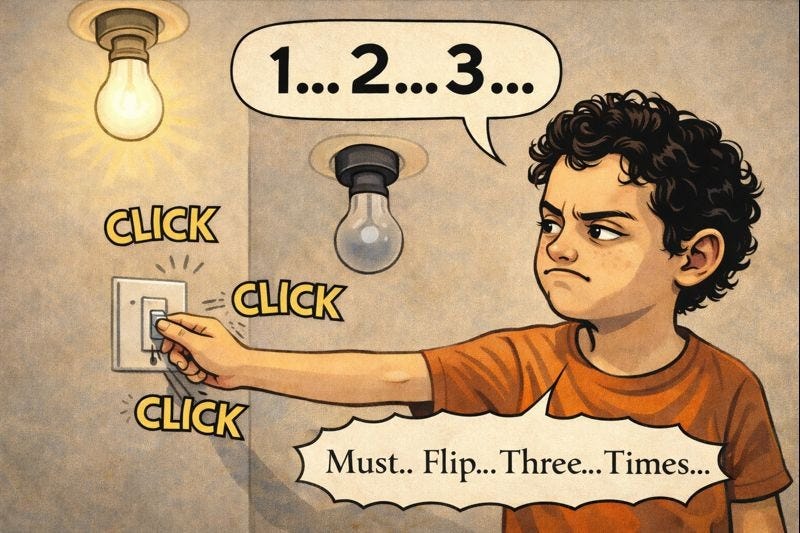
I need you to understand something, though. It is imperative that light-switches are flipped 3 times. Every time and any time they need to be flipped. Yes, always. To be clear, this means that to switch a binary light from off to on, you have to flip it from off to on, from on to off, and then, again from off to on, just so.
This is correct.
This is safe.
This is known.
Some people don’t know this rule. Explaining it to them does not seem to help their bones understand the objective truth or adopt reverence for this universal law. Most times it actually results in one of three predictable outcomes:
Kindly human will explain how this world-view is flawed and attempt to convince you that their world-view is objectively less wrong.
Outcome: I must complete ritual myself.
Less kindly human will explain how holding this world-view is not normal and indicates an inherent flaw in me as a person for holding it.
Outcome: I must complete ritual myself
Optional side-quest: Speak to appointed authority on developmental psychology with an emphatic exploration of home-life, familial relationships, and other potential factors contributing to psychiatric pathology.
Secondary outcome: must be very sneaky about completing rituals or find a way to make penance to universe for non-completions.
Unkindly human intentionally creates conditions that test the bounds of your dedication to ritual completion.
Outcome: Must complete far more ritual cycles than otherwise required while suffering increased social and parental scrutiny.
Of course, this wasn’t an optional experience for me at the time. As a little man, this thing was necessary. I was compelled to flip these light switches. I was committed to locking doors just so. You can only step on every other crack. If a series of cracks ended on an even you must backtrack and leave the sequence early. I created more little rituals than I remember, and I cannot communicate the depth of their importance to me.
They were necessary in the way breathing is necessary once you’ve remembered you are breathing. Like, right now, you are aware of your breathing, and until you stop being aware of your breathing you will have to consciously control that breathing. In this same way, gradually, over time, I began to stop considering my breaths.
There were relapses, where I would think about the switches, knobs, cracks, mirrors, stair numbers, et al, and then have to perform the rituals. However, over time, they lost their individual meaning and, as I evolved, so did the meaning of grounding rituals.
To speak to the elephant in the room:
Yes, these ‘rituals’ were diagnosable obsessive compulsive tendencies.
No, I no longer seem to carry compulsive tendencies in this way.
Yes, there were significant early development traumas which likely manifested these rituals as a direct way to manufacture a sense of order and control over my environment and life.
No, this article isn’t (primarily) about OCD.
As I grew into a big man, other people noticed that I had a pronounced propensity for the creation of ‘rituals’. I really like ‘rituals’. I like having a pre-sleep routine. I dislike but have a morning routine. I enjoy sharing weekly routines with my wife. Sharing dinner and engaging in collective conversations is an important social ritual for me (ask me why some time).
Ritual Design
Through personal experience and the concerted experience of other people’s experiences, I can make a few strong claims about rituals in general.
Let’s try starting this with a visualization.
Imagine yourself, if you will, in a sorting initiation for a ritual, in which you embody said ritual.
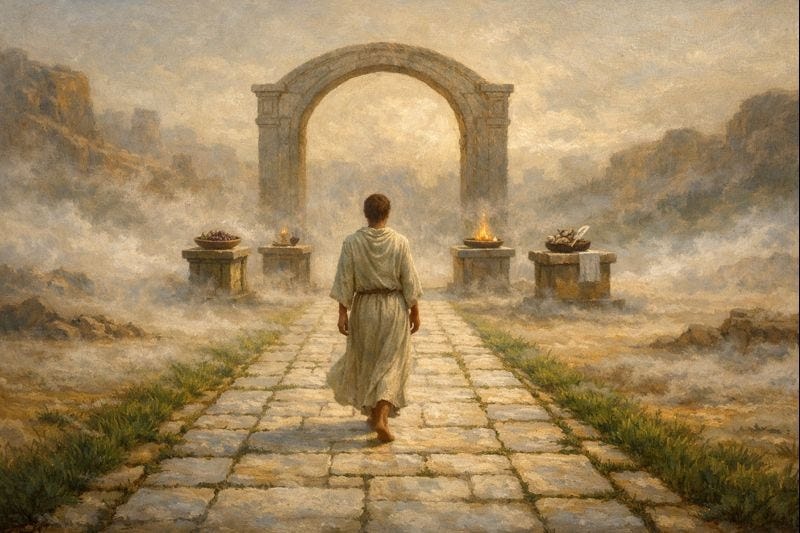
You are walking down a long, white, stone road through a high desert.
Between the stones of the road, moss is growing. A low smoke hangs over the desert floor, smelling not unpleasantly of the soil in a citrus orchard. Citron and stables, with just a hint of cedar forest-floor deadfall.
There is a 3 inch trim of emerald grass along the other edge of the roadway, and the stones are smooth and cool beneath your feet. But not slippery, more a feeling of thinly spread sand.
You are walking confidently but unhurriedly, unaware you needed a specific destination to be walking toward so confidently until just now, and you are still not entirely convinced that you do. Forward itself is a destination. This direction, on this road, is the very definition of forward.
As the road stretches ahead, out into the endless every-no-where, you can vaguely make out a gathering of shapeless something, congregating in the distance. It may be a mirage. The heat haze is very real, radiating off the tiled roadway, mingling with that misty smoke, carpeting the desert.
An archway resolves from an indistinct horizon, and, outside of time, there are no minutes, only steps that you have already taken, as you stretch towards it and come to a meaningful rest. Beyond the archway are four altars. There are no walls, just one archway and four altars with offering plates set in them. Though it seems obvious that you should be able to step around them. You know that you can not. There are only these four altars and the paths that lay beyond them.
You must choose what to offer each.
I have spent way too much time considering how to consider ritual design. The problem I have run into is that anthropologists, sociologists, event marketers, wedding planners, and theologians all have different terminology for describing and categorizing the exact same things.
They each do it in a way that is useful for their specific use case, but it isn’t broadly useful to one another or to ritual designers in general.
The available tools are largely ones of taxonomy and convenience, not meant for use in design.
So, I spent too much time, both my own and that of no few contemporaries, to comprise a ‘straightforward’ system for deciding what category of ritual you are designing. I claim that this is useful because it helps to draw our focus to what exactly is important. Which things are the intended emergent variables, which are the intended controls, and which are the necessary constraints. It’s easy to get lost in costuming, set design, ritual props, and mythos and forget entirely the purpose of the ritual.
Returning to the visualization: you, the ritual, must pass through a series of four gates. Each of these gates has three doors, beyond which lie rituals that look increasingly more meaningfully like you (the ritual) than any and all other rituals do.
To me, intention is very important. Design, preparation, and execution speak loudly to intention. So, even when a ritual doesn’t function quite as designed, to me, it means a world when someone has made the effort to define what it is intended to do.
I have been frustrated for years trying to explain why a ritual, a ritual arc, or a series of rites (the thing) doesn’t quite land for me. I hazard to say that most of the time this happens because the designers, ritual elders, or event producers don’t pay enough attention to a single thing: purpose.
Why the fuck are we even here?
Pryia Parker, in her seminal book on event design, The Art of Gathering, spoke to something deep inside of my neurospicy little experience designer’s soul when she boldly claimed: “A category is not a purpose.” Let me say that in a few ways that might help this land for you, if you haven’t read her book:
A “plant medicine ceremony” is not a purpose.
A “family reunion” is not a purpose.
A “play party” is not a purpose.
A “networking event” is NOT A PURPOSE.
What the event is or even the form it follows is not the same as what it does, how it does it, or why and to whom that doing matters.
The why seems to be the most often overlooked, exaggerated, or outright lied about. Let me give a few examples that drive me absolutely crazy:
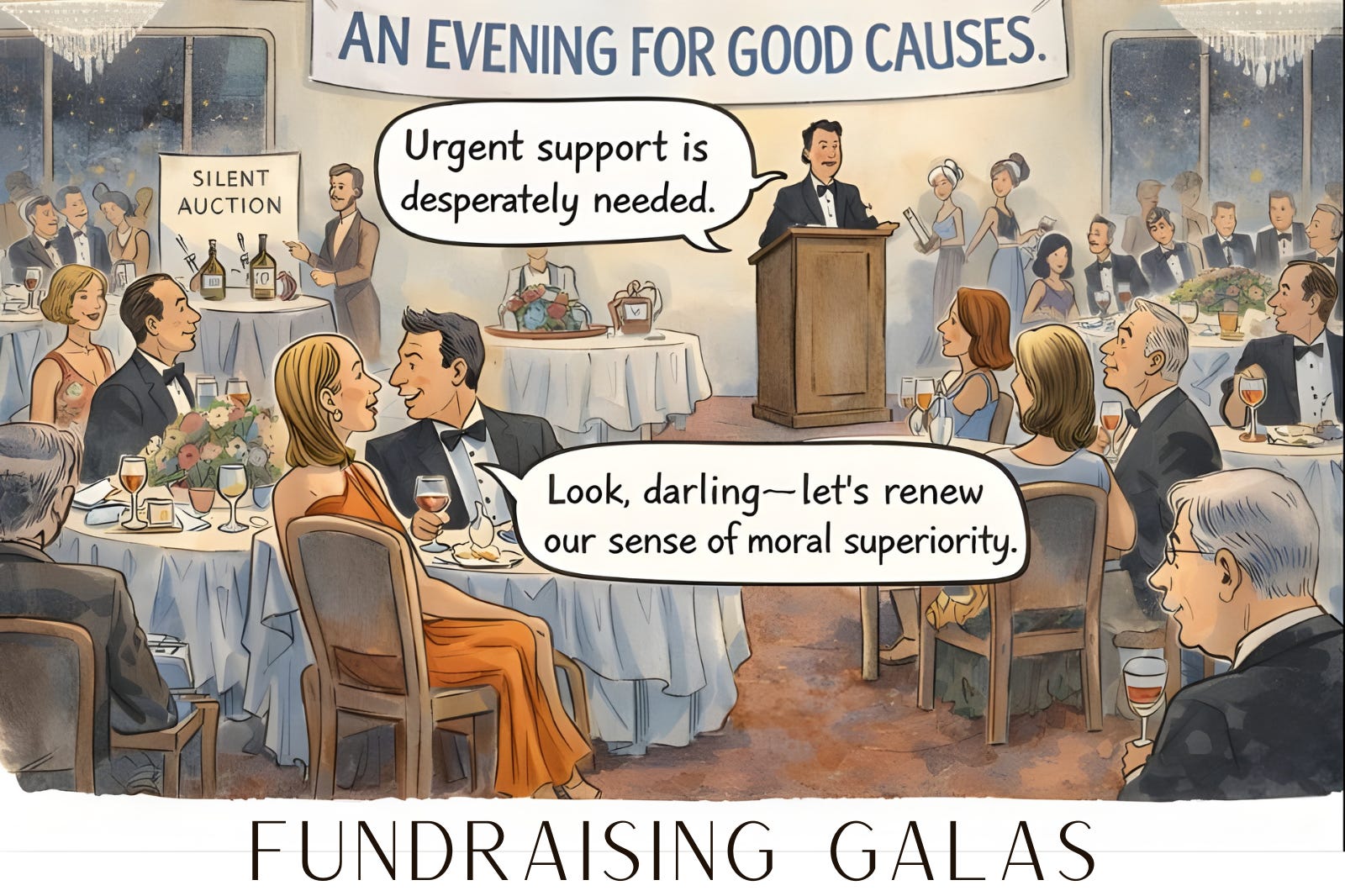
Fundraising Galas.
They claim to be about raising money for the mission. But more often than not, they are about status maintenance, donor theater, and social proof. The “fundraising” is frequently a loss leader, a glossy container designed to lubricate future giving, renew identity as a “good person,” and keep the right people in orbit. None of that is inherently bad. It’s just not honest when the invitation reads like an urgent moral appeal and the actual function is a fancy dinner party with a tax deduction and a silent auction for rich people to cosplay philanthropy.
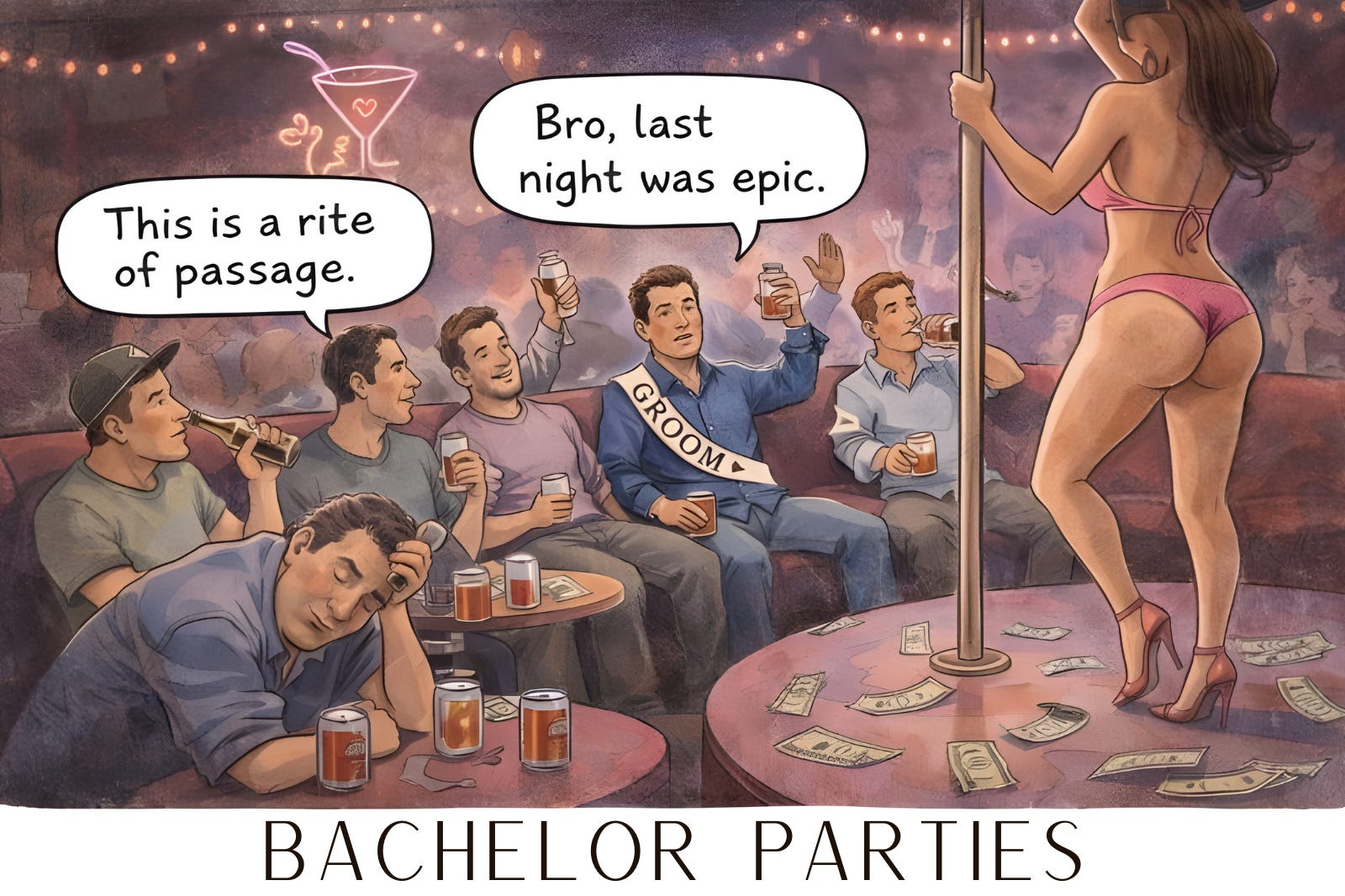
Bachelor Parties.
They claim to be a rite of passage. A sendoff. A threshold. But most are not designed as initiation, they’re designed as sanctioned dissociation. An excuse to externalize fear, grief, and ambiguity as excess. If the real purpose is “let’s celebrate our friend and bless his transition into partnership,” the structure should build that. Instead we often get a culturally approved pressure valve for unspoken dread, and then everyone pretends the hangover was the point.
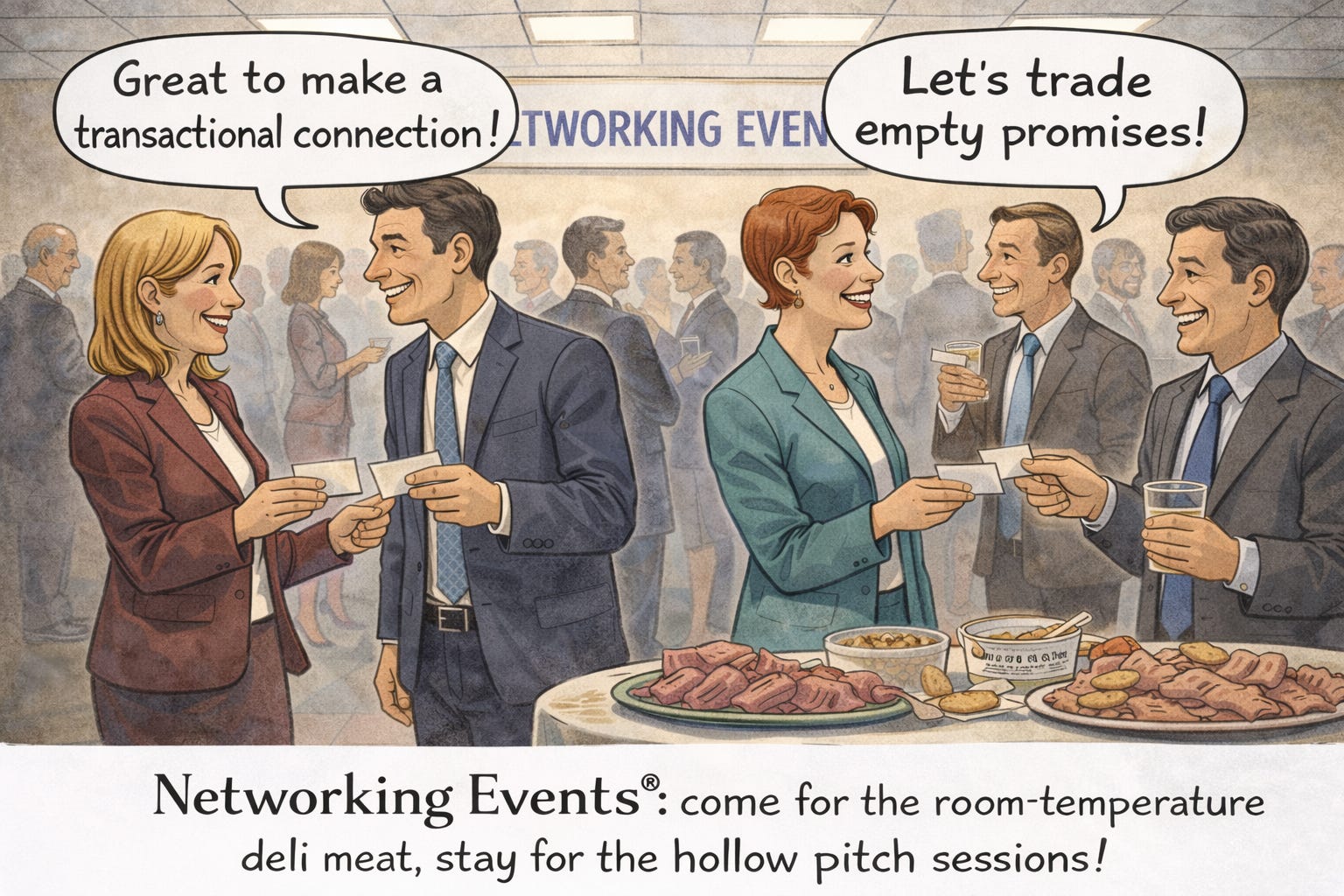
Networking Events.
They claim to be about connection. But most are about lead generation and status sorting. They are marketplaces disguised as community. People show up with smiles that don’t reach their eyes, trading business cards like Pokemon. If the real purpose is “I want business,” say that. If the real purpose is “I want belonging,” then for the love of God, stop making everyone pitch themselves in fluorescent lighting next to a table full of stale hummus and room temperature deli meat.
This is what I mean when I say a category is not a purpose. The form is a costume. The purpose is the function, the mechanism of change. And when the purpose is misnamed, or hidden, or lied about, the participants feel it. They don’t always know why they feel it, but they know they’re being used by a container that won’t name itself.
Form should follow function, and for that to happen, we must clearly and honestly define that function. An event that is produced because:
“We’re bored and we want to remind our friends that we are cool by bribing them into our home with the lures of a socially condoned, time bounded, and inebriation lubricated surrendering of inhibition, in an explicit bid to develop core if hazy memories as a tribal unit and encourage trauma bonding through the shared experiences of exhilaration, pain, and regret.”
Is more likely to be successfully produced than one that is loosely defined as a: “Blessed reunion of our chosen family.” Especially if what you want, as producers, is to fuck around and find out, harkening back to the days of doing inconsequentially hood rat shit with your now responsibility laden friends.
So let’s walk back to the archway.
Four altars. No walls. Your rational brain keeps insisting you should be able to step around them, because you are an adult and altars are not doors, walls, or fences. They are not barriers to passage.
But your bones know better. You recognize the shape of ritual like a tongue forming a familiar prayer.
Most people think the altars can be appeased with offerings of categories.
They think the alters whisper: “wedding, gala, networking, ceremony, retreat, festival, party, healing circle, initiation, whatever”.
Those are costumes hanging on hooks, easily recognizable and begging to be worn.
But the altars are really questions. Four of them. Brutal in their simplicity.
You don’t need a PhD to answer them. You just need a mild allergy to your own bullshit.
And if you want to see what happens when a civilization takes these questions seriously, you don’t need to go to Peru or the Amazon or the edge of some mountain where a man with a rattle tells you your name in a dead language.
You can go to Catholic Mass in a beige Midwestern suburb and watch an institution run a ritual engine so refined it can metabolize hundreds of strangers a week into a single amoebic nervous system that can kneel, confess, receive, and leave lighter than it arrived.
And that’s the part that irritates the modern mind.
Because we want ritual to be either spontaneous and “authentic,” or edgy and bespoke, or aesthetic and Instagrammable.
But the Church? The Church isn’t trying to be interesting. It is trying to be effective. It has one billion users and a two-thousand-year beta test, and it shows.
Why their rituals are so damn good
Mass isn’t “a church service.” Well it is, that’s the category.
It is a weekly act of re-binding. That’s what religion means at the root. To bind again. To bring the self, the community, and the cosmos back into a single story, even if your week has been a dumpster fire of lust, resentment, petty dishonesty, and the quiet terror of your own mortality.
Mass is for sinners so that they can be returned to belonging without pretending they’re innocent.
The event architecture says this before a single word is spoken.
Vestibule. Threshold. Holy water. The cross traced onto meat. A scent that reminds your body to behave. A building that isn’t objectively impressive, but somehow breathes like an ancient thing anyway, because it has been used as an ancient thing often enough to become one.
It moves people through a reliable sequence:
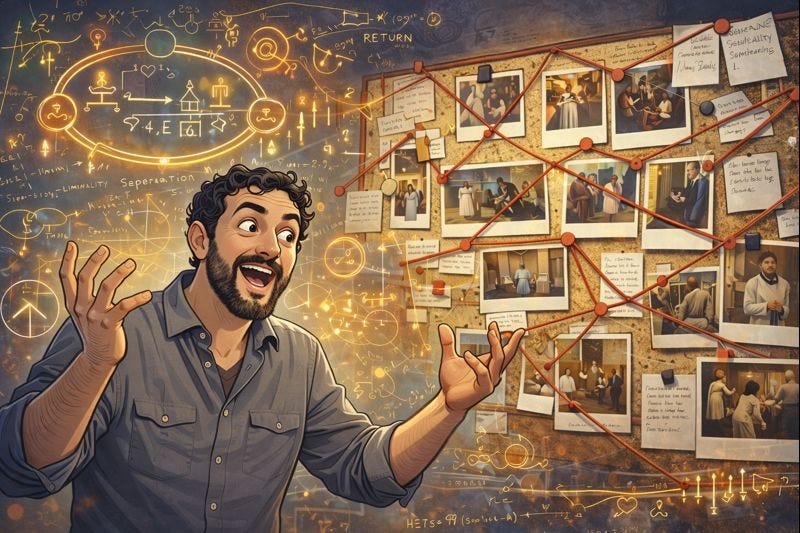
Separation: hats off, phones quiet, the world left outside with the car keys, meeting agendas, and errands.
Liminality: kneeling, chanting, standing and sitting by silent invitation like a willing organism, the self of hundreds of parishioners softening into something permeable.
Return: sacrament taken, absolution imagined or felt, bodies re-seat into ordinary life with a fresh internal alignment, however temporary.
*We’ll return to the classic ritual arc of separation, liminality, and return in another article. Originally introduced by Arnold van Gennep
That’s the wonderfully dirty little secret. Ritual doesn’t need you to believe perfectly. It needs you to participate consistently.
They excel precisely because they don’t rely on your mood. Instead, they rely on repetition, sequence, constraint, and sensory persuasion.
The language can be dead. The priest can be boring. The stained glass can be kitsch. The machine hums on, silently, beneath the sheen of piety, because it was designed to work under imperfect conditions.
The whole ritual is engineered to create a predictable social field:
the lonely plumber dissolves into “we”
the guilty teenager becomes confessable
the exhausted mother feels held
the arrogant man kneels
the grieving widow is witnessed
And the cost of holding that field is distributed across a lineage and a cult of aligned belief: priests, choirs, grandparents, committees, builders, donors, altar boys, volunteers, centuries of people polishing the same wooden pew with their tired asses.
It feels ancient. It is. A moveable feast of accumulated human submission.
Catholic rituals, like other time worn traditions, work because they understand four things most contemporary gatherings try to skip.
They are four load-bearing altars of ritual.
Heart: Who or what is changing and why does that matter?
Heat: How is that accomplished?
Hold: Who or what holds the power?
Home: What do closure and integration look like?
If you can answer those four questions without flinching, you can design almost any experience.
If you can’t, you can still produce an event. It will just have that familiar modern aftertaste: glitter and emptiness. Chewing gum after the flavor’s gone. You keep chewing anyway, because chewing is better than admitting you’re hungry.
Purpose isn’t the theme.
Purpose isn’t the vibe.
Purpose isn’t “community” as a decorative word.
Purpose is the job.
A purpose statement can be poetic. At its core though, it’s utilitarian. The part of the spell where you tell reality what you intend to change.
This ritual is for ___ so that ___ .
It will use ___ to do that.
Held by ___.
We will close by doing ___.
Catholic Mass nails this.
This ritual is for ordinary people who are carrying guilt, grief, longing, and disorder so that they can be re-bind to God, community, and belonging.
It will use repetition, embodied choreography, scripture, symbol, and sacrament to do that.
Held by the priest and the liturgy, under the authority of the Church, with a clear hierarchy and a practiced script.
We will close by doing a final blessing and dismissal, sending people back into ordinary life with a named return-path and the promise of continuity.
Heart: Mass is built to transport a person from isolated, burdened selfhood into re-belonging through confession, absolution, and surrender to something larger than their private story.
Heat: It runs hot enough to crack the ego’s crust and soften the nervous system, but never so hot that the container becomes unpredictable, because the point is replicability, part of the allure is consistency, slipping into mass like an heirloom robe.
*this is a markedly different approach that some newer mega churches whose theme park level spectacle takes a rather shock and awe approach to the seduction of worship*
Hold: Power is openly centralized in priest, liturgy, and doctrine, and every aspect of the ritual design serves to make this explicit through choreography, language, and posture. So no one has to guess who is steering the ship or what the rules are.
Home: It returns people to the profane world with a clean closing and a reliable re-entry, blessing and dismissal. Repetition and continuity, so the sacred doesn’t abandon them at the door but follows them out into the world, living in their lungs, on their tongues, and on their miniature little wall crosses.
The Church engineers threshold and sequence with ruthless consistency, using sensory cues (architecture, smell, silence, holy water), somatic choreography (stand, kneel, genuflect, receive), shared synchronous language (call-and-response, creed, prayer), and a disciplined arc that always completes itself (separation, liminality, return), so meaning is rehearsed into the body until belief becomes less of a weekly conclusion and more a conditioned, communal state.
They are excellent because they are complete. They finish what they start.
In Practice
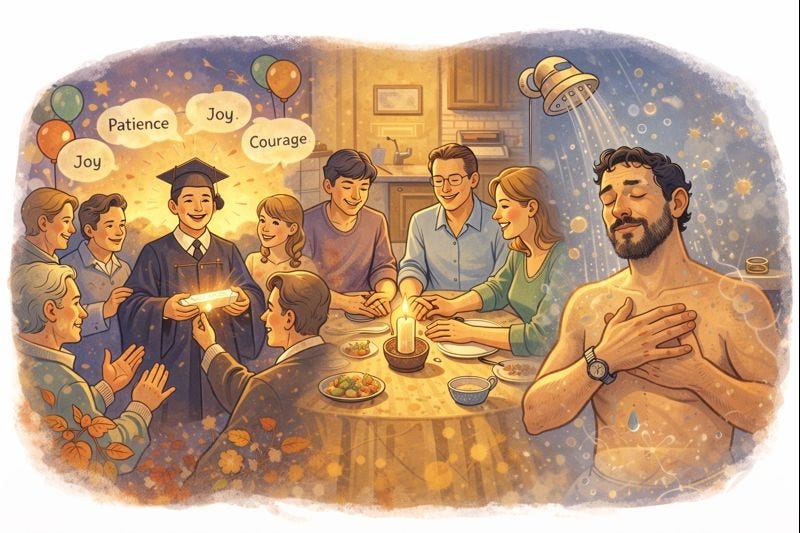
Most modern gatherings kindle a fire and then act surprised when people leave cold and disillusioned or singed and wobbly.
Let’s look at three common rituals and how this design process can help make them whole:
Graduation Party
The default version: sugary snacks, awkward mingling, one speech that makes everyone look at their shoes, and a slow drift into “so… what are you doing next?” interrogation.
Purpose Driven:
This ritual is for the graduate and their people so that a life phase is witnessed, gratitude is made explicit, and the next chapter is welcomed out loud.
It will use story, public witnessing, symbolic handoff, and a small ordeal of attention to do that.
Held by one clear host and two designated “witnesses” who refuse to let it become a generic hangout.
We will close by doing a formal charge, a collective toast, and the giving of a tangible artifact that follows the graduate home.
Mechanisms that make it beautiful:
Threshold moment: everyone signs a “before/after” card at the door: “What I’ve watched you become is…”
Witness circle (12 minutes): 6–8 people pre-selected, each shares one specific story of the graduate’s character, not their résumé.
The handoff: a single object (a key, compass, candle, book) given with one sentence: “This stands for…”
Blessing of the road: the group literally forms a hallway and the graduate walks through while people speak one-word offerings: “Courage.” “Patience.” “Joy.” “Precision.”
Artifact: a sealed envelope they open alone later that night: letters from key people answering: “What I hope you remember when you’re scared is…”
Now it’s not “a party.” It’s a socially sanctioned moment of becoming.
Family Dinner
The default version: food + logistics + low-grade tension + someone scrolling + everyone leaving the table with the same emotional posture they arrived with.
Purpose Driven:
This ritual is for the household so that belonging gets renewed, repair stays current, and the week gets metabolized together instead of alone.
It will use shared nourishment, structured attention, and light recurring practices to do that.
Held by a rotating “table steward” role and one rule everyone protects.
We will close by doing a five-minute integration that sets the tone of the next seven days.
Mechanisms that make it work (without turning dinner into therapy):
One rule: phones are not villains, they’re just not invited to the table.
Opening (60 seconds): everyone places a hand on the table. One breath. The steward says: “We’re here.”
The question (8 minutes): each person answers one prompt, rotating weekly:
“What are you carrying from today?”
“Where did you surprise yourself this week?”
“What do you need more of from us?”
Micro-repair (3 minutes): one tiny thing named and cleared: “I was short with you earlier. I’m sorry.” No debate, just repair.
Closing (2 minutes): each person offers one “sending”: “May you feel steady.” or “May you sleep.”
Optional: the candle: light at start, blow out at end. Your nervous system learns the boundary.
Now dinner becomes a weekly re-binding instead of a weekly .sit-alone-together-and-masticate-athon
Showering
The default version: either a rushed rinse while thinking about emails, or meditation as a self-improvement chore you fail at with impressive consistency.
Purpose Driven:
This ritual is for myself so that attention returns to the body, the day is metabolized, and the nervous system remembers it isn’t trapped.
It will use repetition, sensation, breath, and a single clear intention to do that.
Held by a timer, a boundary, and one chosen constraint you don’t negotiate with.
We will close by doing a deliberate re-entry phrase and one tiny next action that carries the state forward.
Mechanisms that make it real (and not precious):
Constraint: 3 minutes. Non-negotiable. You can do more, but you can’t do less.
Opening line (whispered): “I’m here now.”
Shower as ablution:
first 30 seconds: feel the water, name three sensations
next 60 seconds: exhale longer than you inhale, like you’re wringing stress out of your organs
last 30 seconds: one sentence intention: “Today I will practice ____.”
Closing: turn off the water and say, out loud: “Return.”
Carry-forward token: put on a specific ring/bracelet/scent only after this ritual. Your body learns the sequence.
Now it’s more than simple hygiene or mindfulness. It’s a daily return to stewardship of self.
Purpose is the Engine, Category is the Paint Job
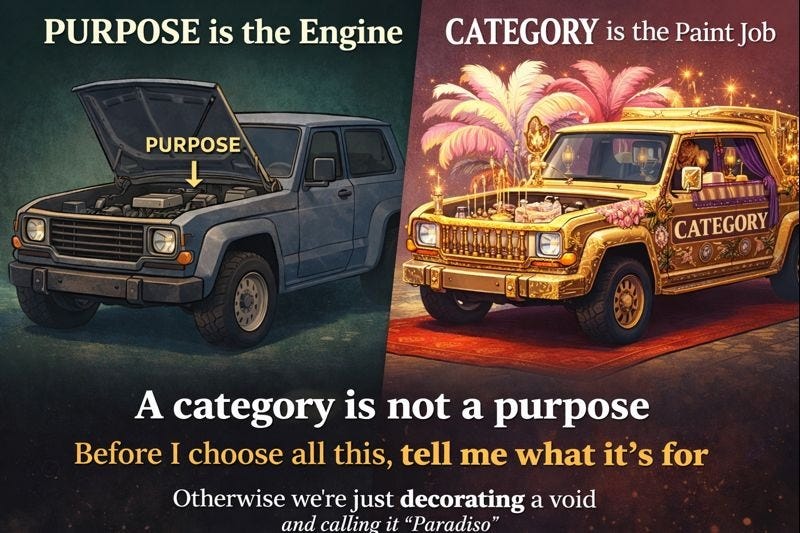
Which is why, when I say “a category is not a purpose,” what I am really saying is:
Don’t stop at calling it a gala.
Tell me whether it is an initiation, a discharge, a threshold, a repair, an integration.
Tell me what it is for.
Tell me what it does.
Tell me who it touches.
Tell me why that matters.
Then, and only then, do we earn the right to choose costumes, lighting, menu, mythos, and props.
Otherwise, we are just decorating a void and calling it ‘Paradiso’.
This is Part 2 in a 5 Part series about Ritual Design.
Origins
Compulsion
Separation
Liminality
Return